


PDF Ebook The Intellectual Devotional Modern Culture: Revive Your Mind, Complete Your Education, and Converse Confidently with the Culturati (The Intellectual Devotional Series), by David S. Kidder Noah D. Oppenheim
This is the book that will encourage you to invest even more times in order making better concept of info as well as understanding to link to all people in the world. One of guides that recent has actually been released is The Intellectual Devotional Modern Culture: Revive Your Mind, Complete Your Education, And Converse Confidently With The Culturati (The Intellectual Devotional Series), By David S. Kidder Noah D. Oppenheim This s the sort of publication that will come to be a brand-new means to the people is drawn in to review a book. This publication tends to be the manner for you to connect one people to others that have very same leisure activity, reading this publication.
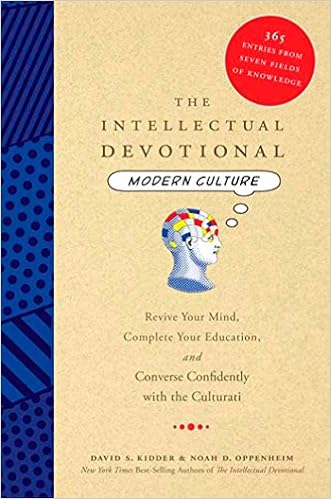
The Intellectual Devotional Modern Culture: Revive Your Mind, Complete Your Education, and Converse Confidently with the Culturati (The Intellectual Devotional Series), by David S. Kidder Noah D. Oppenheim

PDF Ebook The Intellectual Devotional Modern Culture: Revive Your Mind, Complete Your Education, and Converse Confidently with the Culturati (The Intellectual Devotional Series), by David S. Kidder Noah D. Oppenheim
Check now our new updated book collection in this website. As the one of the largest and also most finished website of soft file publications, we constantly restore the collections by updating guides. You could locate some different titles daily that could connect to exactly what you are searching for currently. Among the most offered as well as advertised publication currently is the The Intellectual Devotional Modern Culture: Revive Your Mind, Complete Your Education, And Converse Confidently With The Culturati (The Intellectual Devotional Series), By David S. Kidder Noah D. Oppenheim This publication is advertised for you who are really enjoy with the associated topic.
When you have had this book, it's very cute. When you desire this publication and also still strategy, don't bother, we provide below particularly for you. So, you will certainly not lack The Intellectual Devotional Modern Culture: Revive Your Mind, Complete Your Education, And Converse Confidently With The Culturati (The Intellectual Devotional Series), By David S. Kidder Noah D. Oppenheim when in the shop. Guide that exists is actually the soft documents. As the online library, we reveal you several types and also collections of publications, in soft documents forms. However, it can be acquired wisely as well as easily by seeing the link offered in every page of this website.
Are you still confused why should be this publication? After having fantastic work, you could not need something that is extremely tough. This is just what we state as the practical publication to check out. It will certainly not only give amusement for you. It will provide life lesson behind the entertaining attributes. From this instance, it is definitely that this book is appropriate for you and also for all people who require easy and enjoyable book to read.
After getting this publication somehow, you will see exactly how this publication is really vital for you. It is not just for obtaining the urged books to write however also the remarkable lessons as well as impressions of the book. When you truly enjoy to read, try The Intellectual Devotional Modern Culture: Revive Your Mind, Complete Your Education, And Converse Confidently With The Culturati (The Intellectual Devotional Series), By David S. Kidder Noah D. Oppenheim now and read it. You will never be regret after getting this book. It will certainly reveal you and assist you to get much better lesson.
About the Author
DAVID S. KIDDER is an entrepreneur with a wide range of technology and marketing expertise. Stories about Kidder and his companies have appeared in numerous publications, from the Wall Street Journal to the New York Times. He lives in Westchester, New York. NOAH D. OPPENHEIM, a senior producer of NBC's Today show, has extensive experience in television and print journalism. His writing has appeared in Esquire and the Wall Street Journal. He lives in New York City.
Read more
Excerpt. © Reprinted by permission. All rights reserved.
WEEK 1Sigmund FreudSigmund Freud (1856-1939) was a leading intellectual and psychologist who shaped the study of the human mind in the twentieth century. Through his controversial concept of psychoanalysis, use of hypnosis, and analysis of dreams, he sought to bring light to people's inner lives and motivations, and in doing so, he had a dramatic impact on not only psychology but also philosophy, sociology, and art.Freud's work has seemingly prompted just as many people to call him a charlatan as call him a genius. After graduating from the University of Vienna with a medical degree in neurology, he went to Paris to study under Jean-Martin Charcot (1825-1893), who specialized in the study of hysteria. What Freud saw in treating patients led him to conclude that mental disorders stemmed from psychological or emotional trauma, not physical problems or natural development.While in Paris, Freud began using hypnosis on his patients during psychoanalysis, which led to the development of his central theory: that man is endowed with an unconscious, made up of repressed memories, that has strong emotional and sexual drives. These drives, some of which are born in infancy, battle one another for control and ultimately guide human behavior.In 1899 he published The Interpretation of Dreams, his most widely known work. He theorized that dreams were full of complex symbolism and were an effort by the subconscious to provide clues to human desires.In The Ego and the Id (1923), Freud introduced his theory of the three competing areas of the mind: the id, which is home to the most primitive drives; the ego, which is the conscious self that interacts with reality; and the superego, which recognizes and observes the restrictions imposed by societal norms.His focus on and belief in the power of the unconscious mind led Freud to think that all jokes, slips of the tongue, and dreams had meaning or showed insight into the human mind.ADDITIONAL FACTS1. Freud experimented with cocaine and studied its euphoric effects on himself and others.2. Before devoting himself to psychology, Freud conducted zoological research and is credited with discovering testicles in eels--a small detail that had escaped earlier studies.3. Freud came from an Austrian Jewish family, and four of his sisters died in Nazi concentration camps during World War II.4. Freud's impact on pop culture is clearly visible in works ranging from the television show The Sopranos to the films of Woody Allen (1935-) to the surrealist art of Salvador Dali (1904-1989).Crime and PunishmentIn many respects, Fyodor Dostoyevsky's Crime and Punishment was the first true twentieth-century novel--even though it was published in 1866. This story of murder, guilt, alienation, and redemption set the stage for many modernist and existentialist works of the century that followed, and it continues to make its mark on both literature and film today.Set in St. Petersburg, Russia, the novel focuses on Raskolnikov, a young student who believes himself capable of greatness but feels frustrated by poverty and lack of opportunity. He decides that, because of his extraordinary potential, it would be justifiable for him to kill a miserly old pawnbroker and use her amassed fortune to achieve great things. When he acts on his plan, though, he panics, botches the robbery, and inadvertently kills a second woman without managing to steal the money. Tormented by this failure, Raskolnikov sinks into malaise and questions his real motives for the crime--and all the while is hounded by an investigator who may or may not have any proof of his guilt.Crime and Punishment is renowned as one of the first--and still one of the greatest--examples of the psychological novel, in light of its intricate explorations of Raskolnikov's motivations and mental state. At the same time, it is a remarkable work of suspense: Tension builds as we wonder whether Raskolnikov will get caught or whether he might even confess of his own accord. In fact, much like a crime potboiler, Crime and Punishment was published serially over the course of a year. The novel brought Dostoyevsky (1821-1881) a desperately needed financial windfall that enabled him to catch up on his gambling debts, and his contemporaries, including the novelist Leo Tolstoy (1828-1910), immediately hailed it as a landmark. In the years since, Sigmund Freud (1856-1939), Friedrich Nietzsche (1844- 1900), Jean-Paul Sartre (1905-1980), and Albert Camus (1913-1960), among others, have cited it as a direct influence.ADDITIONAL FACTS1. Crime and Punishment inspired two of Woody Aliens (1935-) most highly regarded films, Crimes and Misdemeanors (1989) and Match Point (2005).2. In his late twenties, Dostoyevsky was sentenced to death by firing squad for participating in meetings of a clandestine left-wing political group. Czar Nicholas I (1796-1855) commuted the sentence at the last minute, and the author was sent to a Siberian labor camp for four years instead--an experience that indisputably inspired parts of Crime and Punishment.3. Dostoyevsky struggled for years with a compulsive gambling habit. Luckily, he was able to mine this compulsion for its literary value, producing the novel The Gambler in 1866.Pyotr Ilyich TchaikovskyRussian composer Pyotr Ilyich Tchaikovsky (1840-1893) wrote several of the most popular ballets in music history, including Swan Lake (1877), The Sleeping Beauty (1890), and his Christmas classic, The Nutcracker (1892). In addition to his dance works, Tchaikovsky composed dozens of orchestral works, including seven symphonies.Tchaikovsky was born in the small Russian town of Votkinsk and began studying piano at the age of five. At first, his parents did not encourage his musical pursuits, believing that a "passionate" hobby would be dangerous for an already frail and sickly child. Eventually, however, Tchaikovsky moved to the Russian capital of St. Petersburg, where he completed his musical education. Czar Alexander III (1845-1894) was an admirer of his work. Another patron, Nadezhda von Meck (1831-1894), granted him a yearly stipend that allowed him to continue his musical endeavors.In addition to his ballets, Tchaikovsky is best known today for his bombastic 1812 Overture (1880), which commemorated the Russian victory over the French emperor Napoleon Bonaparte (1769-1821) and includes cannon fire and church bells as part of the instrumentation. Tchaikovsky also wrote eleven operas. The most famous are Eugene Onegin (1879) and The Queen of Spades (1890), both based on dramatic poems by the nineteenth-century Russian poet Aleksandr Pushkin (1799-1837).Tchaikovsky became popular around the world during his career and toured the United States in 1891, introducing Americans to his now-classic compositions. Two of his works--the 1812 Overture and The Nutcracker--have become sentimental favorites in American culture and are often performed on the Fourth of July and at Christmastime, respectively.ADDITIONAL FACTS1. Tchaikovsky's last work was his Symphony no. 6, entitled Pathetique (1893). The composer died nine days after premiering the work, which was played as a requiem at his memorial.2. Though there was once speculation that Tchaikovsky committed suicide after being exposed in a homosexual affair, most scholars today believe that he died of cholera.3. Though Tchaikovsky's opera Eugene Onegin is considered a masterpiece, the Russian author Vladimir Nabokov (1899-1977) dismissed it as "silly" and "slapdash," saying that everything in it "insults Pushkin's masterpiece."The Lumiere BrothersThe French duo of Louis and Auguste Lumiere did not invent cinema, but they are considered the founding fathers of modern film for creating the primitive motion-picture projector they patented in 1895. The brothers were inspired by the work of American inventor Thomas Edison (1847-1931), who in 1893 had unveiled a machine called the Kinetoscope, which allowed viewers to watch short films by peering into a wooden box that held the device's components.The Lumieres, whose family business manufactured photographic equipment and supplies, improved on the Kinetoscope with the Cinematographe, a lightweight, hand-cranked apparatus that was both a camera and a projector. And unlike the Kinetoscope, which allowed only one viewer to watch the moving pictures, the Cinematographe could project movies onto a screen, allowing members of an audience to watch a movie together.The Lumieres patented the Cinematographe in February 1895, and many historians consider December 28, 1895, to be the birthday of cinema. On that day, the Lumiere brothers projected films for the first time for a paying audience at the Grand Cafe on the Boulevard des Capucines in Paris. The program included ten films--among them Workers Leaving the Lumiere Factory (1895)--and lasted about twenty minutes.In 1896, the brothers took the Cinematographe and their films on a world tour, including stops in London and New York City. According to legend, some spectators were so spooked by Arrival of a Train at La Ciotat (1895)-- which was a single shot of a train as it approached a station from the background--that they ran away in terror.By 1900, the brothers had created 2,000 films. But believing that "cinema is an invention without any future," the brothers did not sell their camera to other filmmakers and went on to focus their efforts on still photography.ADDITIONAL FACTS1. Louis Lumiere (1864-1948) was a trained physicist.2. Auguste Lumiere (1862-1954) ran the family business, which manufactured photographic equipment and supplies.3. The Lumieres hired a pianist to provide live musical accompaniment to their short movies at the first screening in Paris.Communism"A specter is haunting Europe--the specter of communism." With those words, Karl Marx (1818-1883) and Friedrich Engels (1820-1895) opened their 1848 Communist Manifesto, a political broadside that launched one of the most powerful political movements of the nineteenth and twentieth centuries.At the time that Marx and Engels published their pamphlet, communism was a fringe movement associated with a few failed revolts and some obscure and difficult works of German philosophy. A century later, however, it dominated half the globe.The communists believed that the Industrial Revolution of the early nineteenth century had created deep economic inequalities, as factory owners and investors reaped enormous profits while workers toiled in poverty. Capitalism, the communists believed, created great wealth, but the middle class--the bourgeoisie--wanted to maintain their position of power in society instead of sharing it with workers--the proletariat.The solution, Marx and Engels proposed, was for the working class to take control of the means of production themselves, establishing what they termed a "dictatorship of the proletariat." Since the bourgeoisie would never surrender their power voluntarily, Marx and Engels believed, violent revolution was necessary.The communists were hostile not only to capitalism but also to imperialism and religion--which Marx described as "the opium of the people." Indeed, in the eyes of its opponents, communism posed a direct threat to the Western way of life.Amid the poverty and social strife of nineteenth-century Europe, however, communism found many adherents and spread steadily in the years after Marx and Engels's manifesto. With the Russian Revolution of 1917, communists gained the ability to put their ideas into practice.The growing clash between capitalism and communism defined the world politics of much of the twentieth century, particularly the four decades of the Cold War. Although a few nations, such as China, remain nominally communist, the ideology lost much of its allure after the horrors of life in the "worker's paradise" of the Soviet Union were exposed to the world.ADDITIONAL FACTS1. Marx is best known for books such as The Communist Manifesto and the three-volume Capital, but he also worked for many years as a journalist, publishing in British and American newspapers, including the New York Daily Tribune.2. Though communism achieved its first great victory in Russia, Marx and Engels regarded that country as backward and underdeveloped and hoped the communist future would be ushered in by the United States.3. Marx was annoyed when communist philosophy was later labeled Marxism; he once reportedly proclaimed, "I am not a Marxist."James NaismithOf the three great American sports--baseball, basketball, and football-- only one has a true inventor. On December 21, 1891, James Naismith, a Canadian-born physical education teacher, nailed peach baskets to two opposite walls of a gymnasium in Springfield, Massachusetts, handed his students a soccer ball, and announced thirteen rules for his new game--and "basket ball" was born.Naismith (1861-1939), the son of Scottish immigrants, grew up in Ontario and was orphaned by age nine. (His parents died of typhoid fever.) After dropping out of high school at fifteen to work as a lumberjack, he eventually returned to school, earning degrees from McGill University and Presbyterian College, where he studied to become a minister.In 1890, he enrolled at the Young Men's Christian Association (YMCA) International Training School in Springfield. While there, he and his fellow students were given the task of devising an indoor activity for the men at the YMCA to play during the winter, between football and baseball seasons.At the time, calisthenics and gymnastics were essentially the only indoor athletic activities, but they were deemed too boring by many of the men. The only stipulations for the new game were to "make it fair for all players and free of rough play."Naismith's invention proved popular, and his thirteen rules were soon published in a sports magazine to an enthusiastic response. In the following years, Naismith remained prominently involved with the game as it grew, particularly in the evolution of its rules into their current form. In 1898, he took a job at the University of Kansas, where he coached for ten years and remained as an athletic administrator and campus chaplain until shortly before his death at age seventy-eight.ADDITIONAL FACTS1. Naismith's original rules did not permit dribbling--players could advance the ball only by passing.2. Naismith became an American citizen in 1925.3. In his senior year at McGill, an incident on the rugby field changed his life--another player uttered an expletive and, upon seeing Naismith (an aspiring minister), he said, "I beg your pardon, James. I forgot you were there." At this point, Naismith realized that he might be able to help young men improve their lives through spiritual and physical development.4. Naismith is the only coach in University of Kansas history with a losing record. He notched fifty-five wins and sixty losses between 1898 and 1907.Coney IslandLocated at the southern edge of Brooklyn, the amusement parks at Coney Island first opened in the 1890s and reigned for decades as the biggest and most popular in the United States. At its peak, Coney Island drew millions of visitors annually and was famous for carousels, Ferris wheels, roller coasters, fortunetellers, horse racing, freak shows, and, of course, hot dogs.The first rides to open at Coney Island were rickety, often unsafe contraptions. In 1911, for instance, two women died after the roller coaster they were riding, the Giant Racer, jumped from its tracks eighty feet in the air.Still, the parks were enormously popular and attracted an estimated 32 million visitors in 1904. Several vintage rides from the parks' golden age, including the Cyclone, a wooden roller coaster built in 1927, remain in operation.In an era before movies and television, amusement parks were one of the first forms of mass entertainment. Most large American cities built amusement parks in the 1910s and 1920s, although none rivaled the hurly- burly of Coney Island, which comprised several sprawling, privately owned amusement resorts, including Luna Park and Steeplechase Park.
Read more
Product details
Series: The Intellectual Devotional Series
Hardcover: 384 pages
Publisher: Rodale Books; First Edition edition (October 14, 2008)
Language: English
ISBN-10: 1594867453
ISBN-13: 978-1594867453
Product Dimensions:
5.5 x 1.2 x 8.2 inches
Shipping Weight: 1.3 pounds (View shipping rates and policies)
Average Customer Review:
4.4 out of 5 stars
421 customer reviews
Amazon Best Sellers Rank:
#338,632 in Books (See Top 100 in Books)
My ex-boyfriend stole my copy of this, and I liked it so much that I just bought another one.
If you are thinking of buying this book, you should know what you'll be getting. I learned a lot by reading this book, but I suspect that I also absorbed many errors. In MANY of the entries on topics that I already knew something about there were noticeable errors -- mostly minor, but mistakes nonetheless -- which makes me wonder how many errors I absorbed by reading the entries on topics with which I was less familiar. If you don't mind picking up some false information along the way, you may like this book. One other note: I purchased the paperback version, but the print was so small that I then purchased the Kindle edition (which allows you to adjust the font size) so that I could actually read it. So if you find reading really small font difficult, go with the Kindle edition.
I absolutely love these books, the 5 devotional books in this series. The range of information contained within is pretty diverse and each page is different than the previous or the one after, in terms of what I'd expect to see and read about. I have all 5 books now, and I'm really looking forward to reading and absorbing as much info as possible from them. The quality of these books is good, regardless of many of the negative reviews that address the subject. The pages are unevenly cut on the one side of the book, but the top and bottom of the books, the pages are cut evenly. This leads me to believe that the uneven cut of the pages on the side of the book is intentional. Reminds me of books from hundreds of years ago, the way the pages are unevenly cut. I find myself carrying one of these books around with me, for something to read when I only have time to read a page or two, to have something interesting and different to read each time. I really like these books, and I'd recommend them to anyone who has a hunger for knowledge, and/or someone who wants to read but has little time to do so because they lead a busy life. If I had to address anything about these books that would be a realistic critique without being overly critical, it'd be the size of the text. It's on the small side, but I personally have no difficulty reading it. Others may need to put on their reading glasses. Other than that, I see no reason to complain about any of the 'Intellectual Devotional' books. They're pretty great in my opinion. I definitely recommend.
I keep this book on my coffee table and when I'm bored and about to browse on my phone, I'll read one page- it does a great job summarizing a topic or subject and get me thinking. Such a simple book and idea that stimulates thoughtful learning while educating!
Remember that movie "Good Will Hunting" ? In the bar up at Harvard, Matt Damon totally destroys the arrogant undergrad in a battle of history. What a scene eh? Well, by the end of this book, you'll be on a par with the undergrad, so don't pick any intellectual arguments in bars. That's my warning.365 insights into historical events and people who shape or add to the tapestry that is the United states. Great conversation starters or, should someone mention a historical figure you will at least be able to say "Oh yeah, the guy who wrote the National Anthem right?"If you read one page a day, one year later you will probably have learned a few things you didn't already know. Also, these pages serve as good triggers, if your intellect is aroused, into further research.I enjoyed reading the pages, they are concise, and highlight the element(s) of the person that has them suspended in history.Well worth your time.
I really like this book, fun to take to kids sporting events as you don't get immersed in a whole chapter. One page at a time. Plus gives a really nice story with how each one fits together overall. I had checked this book out at the local library, and purchased it to have in my own collection.
If you want to broaden your knowledge base on all types of topics, this is it. The days are quick and easy to read and I can bet the first 30 days you will learn at least 3 new things that you didn't know. My mom gave me this in the hardback form but I also purchased the kindle format so I could change the font size. I have given numerous copies as gifts to my nerdy friends and they all have loved it.
Always looking for something to expand my mind. I've been feeling a bit limited in my daily devotional in reading a Catholic missal alone, and added this and Our Daily Bread to expand the options a bit. Even if one leaves me cold, one of the others usually has something to bring me up a bit,make me think. Using one source was much like sharpening the axe on only one side of the blade. I have to say the wide, not always secular subject approach gives me thought.
The Intellectual Devotional Modern Culture: Revive Your Mind, Complete Your Education, and Converse Confidently with the Culturati (The Intellectual Devotional Series), by David S. Kidder Noah D. Oppenheim PDF
The Intellectual Devotional Modern Culture: Revive Your Mind, Complete Your Education, and Converse Confidently with the Culturati (The Intellectual Devotional Series), by David S. Kidder Noah D. Oppenheim EPub
The Intellectual Devotional Modern Culture: Revive Your Mind, Complete Your Education, and Converse Confidently with the Culturati (The Intellectual Devotional Series), by David S. Kidder Noah D. Oppenheim Doc
The Intellectual Devotional Modern Culture: Revive Your Mind, Complete Your Education, and Converse Confidently with the Culturati (The Intellectual Devotional Series), by David S. Kidder Noah D. Oppenheim iBooks
The Intellectual Devotional Modern Culture: Revive Your Mind, Complete Your Education, and Converse Confidently with the Culturati (The Intellectual Devotional Series), by David S. Kidder Noah D. Oppenheim rtf
The Intellectual Devotional Modern Culture: Revive Your Mind, Complete Your Education, and Converse Confidently with the Culturati (The Intellectual Devotional Series), by David S. Kidder Noah D. Oppenheim Mobipocket
The Intellectual Devotional Modern Culture: Revive Your Mind, Complete Your Education, and Converse Confidently with the Culturati (The Intellectual Devotional Series), by David S. Kidder Noah D. Oppenheim Kindle
0 komentar:
Posting Komentar