


PDF Download Utilitarianism: and the 1868 Speech on Capital Punishment (Hackett Classics)
In investing the leisure time, many people have various ways. But, making the exact same one, reading the Utilitarianism: And The 1868 Speech On Capital Punishment (Hackett Classics) can be done flawlessly. Even it is in different time, you all could obtain the features and also benefits of guide to read. It is sort of publication with the particular subject to get over the everyday problems. When you need kind of entertainment, this publication is additionally appropriate sufficient.
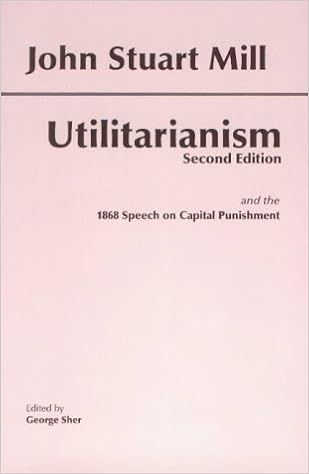
Utilitarianism: and the 1868 Speech on Capital Punishment (Hackett Classics)

PDF Download Utilitarianism: and the 1868 Speech on Capital Punishment (Hackett Classics)
After discovering the book entitle Utilitarianism: And The 1868 Speech On Capital Punishment (Hackett Classics) in this short article, you have found the right publication that could make you really feel pleased. This publication is one of the referred publication options based on necessity. Do you really need this publication as source as well as inspirations? Taking this publication as one of the recommendation could disclose you to have the much-loved publication of yours.
This publication is really correct for the book motif that you are seeking now. Several sources may provide the selection, however Utilitarianism: And The 1868 Speech On Capital Punishment (Hackett Classics) can be the very best means. It is not just one point that you could take pleasure in. A lot more points and also lessons are supplied or you to cover what you precisely require. Lots of readers have to check out guides additionally as a result of the certain factors. Some could enjoy to read it a lot yet some could require it because the task due date.
And just how this book will affect you to do far better future? It will relate to just how the viewers will obtain the lessons that are coming. As understood, generally lots of people will certainly believe that reading can be an entryway to go into the brand-new perception. The understanding will influence how you step you life. Also that is hard sufficient; individuals with high sprit could not really feel bored or quit realizing that concept. It's just what Utilitarianism: And The 1868 Speech On Capital Punishment (Hackett Classics) will give the ideas for you.
In offering the details, we additionally reveal various other book collections. We understand that nowadays many people like checking out a lot. So, locating thousands of guides right here in this online publication is very simple. Searching and also browsing can be done wherever you are. It is the method you make use of the modern-day technology as web connection to attach to this site. From this case, we're really sure that everybody needs are covered in some books, the certain books based upon the subjects as well as requirements. As the Utilitarianism: And The 1868 Speech On Capital Punishment (Hackett Classics) that is now preventative.
Review
Adding the selections from the Speech on Capital Punishment is an excellent idea. --Mark Migotti, University of Calgary
Read more
About the Author
John Stuart Mill
Read more
Product details
Series: Hackett Classics
Hardcover: 88 pages
Publisher: Hackett Publishing Company, Inc.; Second Edition,2 edition (June 15, 2002)
Language: English
ISBN-10: 0872206068
ISBN-13: 978-0872206069
Product Dimensions:
6 x 0.2 x 9 inches
Shipping Weight: 9.1 ounces (View shipping rates and policies)
Average Customer Review:
4.4 out of 5 stars
115 customer reviews
Amazon Best Sellers Rank:
#964,636 in Books (See Top 100 in Books)
I had read "On Liberty" by Mill and thought it was brilliant. However, I had put off reading Utilitarianism because of the way I had heard people describe this particular philosophy. While reading this book, I realized that those people had no understanding of Utilitarianism. I would highly recommend this book. John Stuart Mill had an IQ of 190 and was trained from a very young age to take up the cause where Jeremy Bentham left off. I think my biggest takeaway from the book is that one must act with nobility (honor, goodness, decency integrity) when pursuing the Greatest Happiness principle that is Utilitarianism. In other words, taking from 1 person to give to 2 other people, although increasing overall happiness, does not qualify as Utilitarian act because it is no decent to take what does not belong to you.
A nice (relatively) short yet interesting read. At approximately 100 pages this wasn't horribly time consuming to digest. While I think John Stuart Mill could have done without the long-winded defense of utilitarianism in comparison to other prevailing philosophical thought of the time I can see the necessity of starting his discussion this way. Besides the fact that I find utilitarianism to just be a written statement of general human feeling, his discussions on defining happiness, balancing happiness with cost, and personal vs. community happiness to be extremely interesting.
Great introduction, notes, and bibliography. Yes, you could read Utilitarianism for free on the internet, but with these resources available, why would you?
Made me think on a whole different level. Some very long sentences made it hard to follow but very interesting
J. S. Mill's book "Utilitarianism" is a classic exposition and defense of utilitarianism in ethics. The essay first appeared as a series of three articles published in Fraser's Magazine in 1861; the articles were collected and reprinted as a single book in 1863. Mill's aim in the book is to explain what utilitarianism is, to show why it is the best theory of ethics, and to defend it against a wide range of criticisms and misunderstandings. Though heavily criticized both in Mill's lifetime and in the years since, "Utilitarianism" did a great deal to popularize utilitarian ethics and is probably the most influential philosophical articulation of a liberal humanistic morality that was produced in the 19th century. Largely owing to Mill, utilitarianism rapidly became the dominant ethical theory in Anglo-American philosophy for the better part of a century. Though few contemporary ethicists today would agree with all elements of Mill's hedonistic moral philosophy, utilitarianism remains a live option in ethical theory today, and Mill's book is unquestionably the most famous defense of the utilitarian view ever written and is still widely assigned in university ethics courses around the world.Mill took many elements of his version of utilitarianism from Jeremy Bentham, the great 19th-century legal reformer, who along with William Paley were the two most influential English utilitarians prior to Mill. Like Bentham, Mill believed that happiness (or pleasure, which both Bentham and Mill equated with happiness) was the only thing humans do and should desire for its own sake. Since happiness is the only intrinsic good, and since more happiness is preferable to less, the goal of the ethical life is maximize happiness. This is what Bentham and Mill call "the principle of utility" or "the greatest-happiness principle." Both Bentham and Mill thus endorse "classical" or "hedonistic" forms of utilitarianism. (More recent utilitarians often deny that happiness is the sole intrinsic good, arguing that a variety of values and consequences should be considered in ethical decision making.) Although Mill agreed with Bentham about many of the foundational principles of ethics, he also had some major disagreements. In particular, Mill tried to develop a more refined form of utilitarianism that would harmonize better with ordinary morality and highlight the importance in the ethical life of intellectual pleasures, self-development, high ideals of character, and conventional moral rules."Utilitarianism" contains five chapters. In chapter 1, titled "General Remarks" Mill notes that there has been little progress in ethics. Since the beginning of philosophy, the same issues have been debated over and over again, and philosophers continue to disagree sharply over the basic starting points of ethics. Mill argues that these philosophical disputes have not seriously damaged popular morality, largely because conventional morality is substantially, though implicitly, utilitarian. He concludes the chapter by noting that he will not attempt to give a strict "proof" of the greatest-happiness principle. Like Bentham, Mill believed that ultimate ends and first principles cannot be demonstrated, since they lie at the foundation of everything else that we know and believe. Nevertheless, he claims, "[c]onsiderations may be presented capable of determining the intellect," which amount to something close to a proof of the principle of utility.In chapter 2, Mill formulates a single ethical principle, the principle of utility or greatest-happiness principle, from which he says all utilitarian ethical principles are derived: "The creed which accepts as the foundation of morals utility, or the greatest happiness principle, holds that actions are right in proportion as they tend to promote happiness, wrong as they tend to produce the reverse of happiness. By happiness is intended pleasure, and the absence of pain; by unhappiness, pain, and the privation of pleasure. Mill then spends the bulk of chapter 2 responding to a number of common criticisms of utilitarianism. These include charges that utilitarianism:- is a doctrine worthy only of swine (for holding that pleasure is the only thing that is desirable for its own sake)- fails to recognize that happiness is unobtainable- is too demanding (for claiming that it is always our duty to create the greatest possible happiness in the world)- makes people cold and unsympathetic (by focusing solely on the consequences of actions, rather than on features such as motives and character, which require a more sensitive and empathetic response)- is a godless ethics (by failing to recognize that ethics is rooted in God's commands or will)- confuses goodness with expediency- fails to recognize that in making ethical decisions there usually isn't time to calculate future consequences- tempts people to disobey ordinary moral rules (by inviting them to ignore such rules when they appear to conflict with the general happiness)In response to the charge that utilitarianism is a doctrine fit only for swine, Mill abandons Bentham's view that pleasures differ only in quantity, not quality. He notes that most people who have experienced both physical and intellectual pleasures tend to greatly prefer the latter. Few people, he claims, would choose to trade places with an animal, a fool, or an ignoramus for any amount of bodily pleasure they might thereby acquire. And since "the sole evidence it is possible to produce that something is desirable, is that people do actually desire it," it follows that intellectual pleasures (e.g., the pleasures of friendship, art, reading, and conversation) are higher and more desirable kinds of pleasures than bodily pleasures, and that a rational pursuit of one's long-term happiness requires development of one's higher faculties.In reply to the objection that there generally isn't enough time to calculate how a given act might affect the long-term general happiness, Mill sketches a kind of "two-tier" approach to ethics that accords an important place to moral rules in ethical decision-making. Mill argues that traditional moral rules such as "Keep your promises" and "Tell the truth" have been shown by long experience to promote the welfare of society. Normally we should follow such "secondary principles" without reflecting much on the consequences of our acts. As a rule, only when such second-tier principles conflict is it necessary (or wise) to appeal to the principle of utility directly.In chapter 3, Mill asks what "sanctions" (i.e., rewards and punishments) undergird the obligation to promote the general happiness. He explores a variety of ways in which both external and internal sanctions -- that is, the incentives provided by others and the inner feelings of sympathy and conscience – encourage people to think about how their actions affect the happiness of others. The ultimate sanction, Mill claims, is internal. Humans are social animals who naturally desire "to be in unity with our fellow creatures." To prefer selfish goals over the public good runs counter to this deep-seated natural impulse.In chapter 4 Mill offers his famous quasi-proof of the greatest-happiness principle. The core of his argument is this: Everyone desires happiness; ehe only proof that something is desirable is that people do actually desire it; so, each person's happiness is a good to that person; therefore, the general happiness is a good to the aggregate of all persons. Many critics have claimed that this argument relies on a dubious assumption about how individual happiness is related to the general happiness. There might be times when the general happiness can only be promoted by sacrificing the happiness of certain individuals. In such cases, is the general happiness a good to those individuals? Other critics have questioned whether it makes sense to speak of aggregates as having desires, or whether the fact that something is desired proves that it is desirable.The fifth and longest chapter concludes by discussing what Mill considers "the only real difficulty" with utilitarian ethics: whether it might sometimes license acts of flagrant injustice. Critics of utilitarianism often claim that judging actions solely in terms of their effects on the general happiness is incompatible with a robust respect for individual rights and a duty to treat people as they deserve. Mill appreciates the force of this objection and argues that feelings of justice are rooted in both a natural human desire to retaliate for injuries and a natural instinct for sympathy for those who have been wrongly injured; that justice has a utilitarian basis since an injustice is committed only when a person's rights have been violated, and an alleged right should be protected by society only when doing so promotes the general happiness; that people disagree deeply about what sorts of things are and are not just, and utilitarianism provides the only rational basis for resolving such conflicts.
ordered this for school. came in great condition and was a good price.
Good historical background but tough to follow trains of thought. Not sure if JSM sees the concept of utilitarianism and happiness as the same thing
Book was in good condition. Had to buy for a philosophy course.
Utilitarianism: and the 1868 Speech on Capital Punishment (Hackett Classics) PDF
Utilitarianism: and the 1868 Speech on Capital Punishment (Hackett Classics) EPub
Utilitarianism: and the 1868 Speech on Capital Punishment (Hackett Classics) Doc
Utilitarianism: and the 1868 Speech on Capital Punishment (Hackett Classics) iBooks
Utilitarianism: and the 1868 Speech on Capital Punishment (Hackett Classics) rtf
Utilitarianism: and the 1868 Speech on Capital Punishment (Hackett Classics) Mobipocket
Utilitarianism: and the 1868 Speech on Capital Punishment (Hackett Classics) Kindle
0 komentar:
Posting Komentar