


Download Ebook Journal 1935-1944: The Fascist Years (Published in association with the United States Holocaust Memorial Museum)
Lots of people that achieve success and smart have excellent analysis habit. Even their reading products are various. When you are diligent enough to do checking out on a daily basis, also couple of mins in your extra time, your success and also stature will establish. The people who are looking at you might be admired regarding exactly what you do. It will certainly offer little self-confidence to enhance. So, when you have no idea concerning what to do in your downtime currently, let's inspect to the link to get the Journal 1935-1944: The Fascist Years (Published In Association With The United States Holocaust Memorial Museum) and also read it earlier.
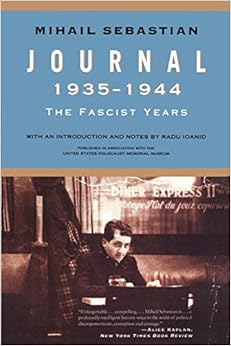
Journal 1935-1944: The Fascist Years (Published in association with the United States Holocaust Memorial Museum)

Download Ebook Journal 1935-1944: The Fascist Years (Published in association with the United States Holocaust Memorial Museum)
There are many suggestions that individuals provide to enhance the life quality, regarding everything. Here, we also will provide you a very easy idea to life much better. Checking out Journal 1935-1944: The Fascist Years (Published In Association With The United States Holocaust Memorial Museum) is our idea. Please ask why we suggest this publication to review. Many individuals try to make themselves to be abundant, yet sometime they forget about a very simple thing. Checking out is in fact a simple thing, but lots of are lazy to do it. It's sort of boring activity and also waste the moment.
The Journal 1935-1944: The Fascist Years (Published In Association With The United States Holocaust Memorial Museum) that we provide for you will be supreme to offer choice. This analysis book is your selected book to accompany you when in your leisure time, in your lonesome. This kind of book could aid you to heal the lonely and also get or include the motivations to be more inoperative. Yeah, book as the widow of the world can be really inspiring good manners. As below, this book is likewise produced by a motivating author that can make influences of you to do even more.
When some individuals believe that this is a tough publication to review, we will certainly inform you that it turns into one of the smarter ideas to come with something different. The different points of the Journal 1935-1944: The Fascist Years (Published In Association With The United States Holocaust Memorial Museum) with other publications are lasting on the way just how the author improvisate as well as select the topic commonly and also surprisingly. It will certainly be timeless and limitless to earn all people really feel embellished as well as impressed of this book.
Based upon this problem, in order to help you we will reveal you some ways. You could take care of to read the book minimally prior to going to sleep or in your spare time. When you have the moment in the short time or in the vacation, it can assist you to complete your vacations. This is exactly what the Journal 1935-1944: The Fascist Years (Published In Association With The United States Holocaust Memorial Museum) will minimally give to you.
Review
This extraordinary personal diary, describing, day by day, the ‘huge anti-Semitic factory’ that was Romania in the late 1930s and early 1940s, deserves to be on the same shelf as Anne Frank’s Diary and to find as huge a readership. Sebastian is no child, however—his is a sophisticated literary mind observing in horror, and then portraying with a fluid, lucent pungency, the cruelty, cowardice, and stupidity of his worldly Gentile friends in Bucharest’s urban cultural elite as they voluntarily transform themselves into intellectual criminals and, allied with the Nazis, participate with fanatical conviction in ‘an anti-Semitic delirium that nothing can stop.’ (Philip Roth)This book is alive, a human soul lives in it, along with the unfolding ghastliness of the last century, which passed an inch away from Sebastian's nose. Here is a life whose spell will last a long time. (Arthur Miller)An extraordinary testimonial. . . . The sickening coziness of artistic and political worlds in fascist Romania is caught in the very process of ‘rhinocerization,’ to use Eugène Ionesco’s famous coinage. . . . Sebastian’s Journal is an uncomfortable and convincing reminder that the Romanian, indeed European, intellectual milieu still had something morally rotten at its core. This book rises from the debris of pre-war verbiage like a man from a pile of corpses. (Andrei Codrescu)This journal stands as one of the most important human and literary documents of the pre-Holocaust climate in Romania and Eastern Europe. . . . Remarkable. (Norman Manea, author of "The Hooligan’s Return")Like all great works, Journal generates its own actuality. Discovering and reading it today, more than half a century after it was written, is a shattering and overwhelming experience. What is particularly admirable in this diary is Mihail Sebastian himself: he cannot help remembering that these fascists have been his former friends during their common youth, and he is able to feel sorrow when one of them dies. Even when he is himself marked and hunted, even when his own life is at stake, even when the horror culminates in the massacre at Jassy, even when he is beyond disgust and revulsion, he never loses his sense of justice, nor his humanity. He remains through and through a Just. (Claude Lanzmann)Unforgettable . . . compelling. . . . Mihail Sebastian is an unparalleled diarist . . . a profoundly intelligent literary voice in the midst of political disempowerment, corruption and carnage. (Alice Kaplan The New York Times Book Review)Rightly compared to Viktor Klemperer's great diary of life under the Nazis, I Will Bear Witness. . . . Critics have commented that Sebastian, being more literary . . . was the more elegant writer. Both diaries are indispensable. . . . From now on, the history of Fascist Romania and Nazi Germany cannot be written without them. (Peter Gay The New York Review Of Books)Sebastian’s Journal proves to be one of the most important testimonies of the Jewish tragedy during that period, comparable to Primo Levi’s Survival in Auschwitz or the diary of Anne Frank. Unlike Levi and Frank, who write from inside Hell, portraying life in the concentration camps or in hiding, Sebastian writes with honesty and analytic acuity from the purgatory of his own room in Bucharest, where he lives with the impending danger of deportation and death, questioning the moments of ease that his provisional freedom allows him: the enjoyment of music, of love affairs, of reading books, writing, or learning English. (The New Yorker)Nuanced, gracefully written, spellbinding, gripping, and eloquent. (National Public Radio)Searing . . . haunting. (Parade Magazine)
Read more
About the Author
Mihail Sebastian was born in 1907 to a middle-class Jewish family in the Danube port of Braila; he died in an automobile accident in the spring of 1945. During the period between the wars, he was well known for his lyrical and ironic plays and for urbane psychological novels tinged with melancholy, as well as for his extraordinary literary essays.
Read more
Product details
Series: Published in association with the United States Holocaust Memorial Museum
Paperback: 672 pages
Publisher: Rowman & Littlefield Publishers; Reprint edition (November 7, 2012)
Language: English
ISBN-10: 1442220244
ISBN-13: 978-1442220249
Product Dimensions:
5.8 x 1.7 x 8.8 inches
Shipping Weight: 1.8 pounds (View shipping rates and policies)
Average Customer Review:
4.2 out of 5 stars
12 customer reviews
Amazon Best Sellers Rank:
#1,145,398 in Books (See Top 100 in Books)
Review by Gabrielle GouchHistory! All countries distort it and communist Romania was no exception. That is why Mihail Sebastian’s book - a raw record of his life and the major political events in Romania between 1935-1944 - is so important.As weeks turn to months and months turn to years, the reader witnesses the gradual introduction of anti-Jewish laws. From confiscation of their houses and their possessions, including radios, to outlawing practicing their professions. From financial penalties, to forced labour. Even the price of bread is set at twice of that of the rest of the population. Credit, where credit is due, the inventiveness of the fascist government had no bounds. In time these laws would drive Sebastian into poverty and often despair.At first he is puzzled seeing his mentor and his best friends - high calibre intellectuals - becoming infatuated with the poisonous Nazi ideology. Later, he still meets them on occasions, but finds them repugnant.Without a radio, with his only source of news the German communiques, bragging about their victories, then more and more secretive as their luck turns, all Sebastian can do is speculate. But the progrom in his own city is no speculation. Neither is the queue of Jews about to be deported - he walks past. The fear and dread that one day it might be him standing there, would never be far from his mind. And yet when a well-wisher says to him to convert to Christianity - which in those days could have made the difference between life and death - despite being a secular Jew, he refuses. That’s moral fortitude!This book is about far more than war. It is also about literature. Among them Balzac and Proust, Shakespeare and Yates and even Jane Austin. He admires them, he comments about their techniques. But I found his own struggles with writing, the ups and downs of the creative process most interesting. And so are his doubts about writing when other people are murdered. It took fifty years for this book to be published and how grateful I am that it was.I grew up in Romania during the communist times. The history we learnt was mostly about class struggle. It did not mention Jews or Holocaust.My parents who lived in Brasov - where Sebastian went sometimes to ski - told me that their house was confiscated, but not about the other struggles, or their fear that they could be deported any day. My impression was that Hungary, from where hundreds of thousands of Jews were taken to be murdered, was far worse. So I was always grateful to Romania for my parents’ lives.Sebastian’s book has affected me greatly, and this an understatement.
After finishing this book over a week ago I find it persists, stays present in my mind. I learned a lot, not specific information but rather from the immersion that I experienced while reading the journal. I was moved. First some general information about the book:The author is an unmarried Jewish writer in his 30s living in Bucharest, Romania. His journal encompasses that period when Hitler was ascendant in Germany and throughout most of the war that ensued. He wrote plays, translated literature and had written a successful novel of his own. He moved in a large circle of friends and acquaintances, some of whom were important public figures in Bucharest. He liked classical music. Poverty was always close at hand, scrambling for money to pay rent is a frequent topic in his day to day endeavors. He's also quite self-critical, does not carry his proportional share of self esteem.Starting at the beginning I read along but became somewhat disappointed. I was just not that interested in how he struggled over the specifics of the writing he was doing. Nor his descriptions of the classical music that he heard on the radio. So I jumped ahead to his 1939 year and continued till the end, December 1944. Throughout there are many people involved, lots of names to make sense of. I had limited success. On average there are probably one or two entries for a week, generally succinct and without excess baggage.His writing drew me in, Day by day he was following the events of the War in Europe, knowing that the stakes were huge. And his observations were often prescient regarding what lay ahead. Present throughout are the difficulties and indignities that he lived as a Jew in Bucharest. And fear. Week after week, year after year there was just meanness in the official edicts that were laid upon the Jews. Sebastian had friends who were both Jewish and non-Jewish, and the reader is struck at how little empathy or care is shown by the non-Jewish ones.I also came to understand how the European Jews failed to flee to foreign places when the danger was obvious and arising. Sebastian had his work and his friends and his family all living in Bucharest. And considering what was going on elsewhere in Europe it is not clear that there was any real, viable alternative. Perhaps the United States, but that was a long ways away and emigration to the US was not easy.Personally I often feel quite critical of contemporary Israel. But this reading really helps me more fully understand the origin of the mindset that endures in the European Jewish community. This book will leave its mark on you, a valuable one..
Journal 1935-1944: The Fascist Years (Published in association with the United States Holocaust Memorial Museum) PDF
Journal 1935-1944: The Fascist Years (Published in association with the United States Holocaust Memorial Museum) EPub
Journal 1935-1944: The Fascist Years (Published in association with the United States Holocaust Memorial Museum) Doc
Journal 1935-1944: The Fascist Years (Published in association with the United States Holocaust Memorial Museum) iBooks
Journal 1935-1944: The Fascist Years (Published in association with the United States Holocaust Memorial Museum) rtf
Journal 1935-1944: The Fascist Years (Published in association with the United States Holocaust Memorial Museum) Mobipocket
Journal 1935-1944: The Fascist Years (Published in association with the United States Holocaust Memorial Museum) Kindle
0 komentar:
Posting Komentar