


Free PDF
This is some of the advantages to take when being the participant and obtain the book here. Still ask what's different of the other site? We give the hundreds titles that are developed by suggested authors as well as publishers, all over the world. The connect to buy and also download is also really simple. You might not discover the complicated site that order to do more. So, the way for you to get this will be so simple, won't you?

Free PDF
Collection and also publication shop are two crucial locations to get the books to read. Nevertheless, in contemporary era, it will not only evoke both areas. Lots of websites are now offered for the internet library. As here, discovering the numerous books titles from within and also beyond this country is simple. You could not only intend to take the book but likewise casual education. As revealed, library can be an informal education system to spread out the expertise, from any resources.
The other interesting publications may be varieties. You could locate them in additionally attractive title. Yet, what make you attracted to select is that it has different style as specified. The language belongs to be the simple language use. How the writer communicates to the visitors is very clear and also readable. It makes you really feel easy to understand specifically when the author talks about.
One to bear in mind when mosting likely to read this publication is setting the time perfectly. Never try it in your rushed time, of course it could interrupt you not to obtain bad thing. This publication is really extended as it has various method to tell as well as explain to the visitors, from however about this book components. You could really feel initially concerning what sort of truths to give in this , however, for sure, it will undergo for others.
So simple! This is exactly what you could utter when getting guide when others peoples are still puzzled of where when they can own this book, you could take it today by finding the link that is in this site and also click it quicker, you can be overview of the fie of the So, it will certainly not require long period of time to wait, furthermore every days. When your web connection is properly done, you could take it as the favored publication, your choice of guide appertains enough.
Product details
File Size: 2745 KB
Print Length: 423 pages
Publisher: WSPC (September 1, 2011)
Publication Date: September 1, 2011
Sold by: Amazon Digital Services LLC
Language: English
ISBN-10: 9814390593
ISBN-13: 978-9814390590
ASIN: B008WXT92C
Text-to-Speech:
Enabled
P.when("jQuery", "a-popover", "ready").execute(function ($, popover) {
var $ttsPopover = $('#ttsPop');
popover.create($ttsPopover, {
"closeButton": "false",
"position": "triggerBottom",
"width": "256",
"popoverLabel": "Text-to-Speech Popover",
"closeButtonLabel": "Text-to-Speech Close Popover",
"content": '
});
});
X-Ray:
Not Enabled
P.when("jQuery", "a-popover", "ready").execute(function ($, popover) {
var $xrayPopover = $('#xrayPop_58E28764431411E9BB79DCA6CECF28F7');
popover.create($xrayPopover, {
"closeButton": "false",
"position": "triggerBottom",
"width": "256",
"popoverLabel": "X-Ray Popover ",
"closeButtonLabel": "X-Ray Close Popover",
"content": '
});
});
Word Wise: Enabled
Lending: Not Enabled
Enhanced Typesetting:
Enabled
P.when("jQuery", "a-popover", "ready").execute(function ($, popover) {
var $typesettingPopover = $('#typesettingPopover');
popover.create($typesettingPopover, {
"position": "triggerBottom",
"width": "256",
"content": '
"popoverLabel": "Enhanced Typesetting Popover",
"closeButtonLabel": "Enhanced Typesetting Close Popover"
});
});
Amazon Best Sellers Rank:
#117,016 Paid in Kindle Store (See Top 100 Paid in Kindle Store)
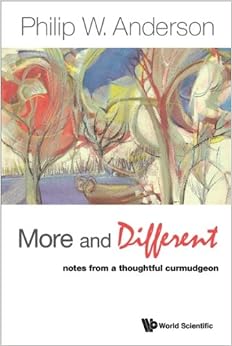
Phil Anderson’s most recent collection of essays highlights the portion of his career that has been dedicated to thinking about, rather than doing science. Such reflection is a common avocation among physicists, and Anderson has an uncommon gift for resisting the temptations of glib generalization and grandiose rhetoric, which so frequently beguile the reflexive physicist. The essays Anderson highlights here are predominantly purpose-written pieces—editorials, book reviews, lectures, etc. We are permitted thereby to see Anderson and his views in context, rather than filtered through the lens of hindsight. The volume is an excellent compendium of the portion of Anderson’s career for which, justly or not, he is best known.Emergence is the watchword that sums up Anderson’s agenda. If the sum of this book’s essays can be said to have a common goal, it is the advancement of the idea that science, in its most fascinating, fruitful, and as yet poorly understood form, grapples with how to understand complex phenomena by examining how new, novel, unpredictable laws emerge from simple constituents. Anderson recalls arriving at this view through his own scientific work, particularly in the aftermath of the Bardeen-Cooper-Schrieffer theory of superconductivity, which awakened the physics community to the importance of spontaneous symmetry breaking. He also extends this view beyond physics, to the “seamless web†of science as a whole, embracing—reservedly—the hope that techniques honed investigating complex physical systems might offer insight to the study of complex biological, social, and economic systems.Seen as a paean for emergence, the book might be split roughly in half. Anderson develops his emergentist view of science in the first. In the second, we see it applied to a series of debates, of both contemporary and historical interest. The first half begins with a series of historical recollections. The most substantial of these are the two chapters, excerpts from Anderson’s unpublished history of superconductivity. These strike a balance between biographical background and clear exposition of conceptual details. Sections III and IV contain what is likely to be the most interesting material for many readers. They outline Anderson’s views on emergence, present his attack on reductionist theories of everything, and outline thoughts on how a national science infrastructure organized his way might look.The second half is less focused. Its many tangents include reflections on the nature of scientific genius, lamentations about the hopelessness of futurology, arguments against the wisdom of Strategic Defense Initiatives, and a small spat with Nancy Cartwright over the epistemological foundations of science. Section IX on complexity picks up the thread of the first half again before the final section, “Popularization Attempts,†attempts to articulate what it is condensed matter physicists do in a manner that is, alas, likely to exceed the grasp of most lay readers; Anderson’s scrupulous habit of presenting his arguments in all their nuance and complexity, which is an asset elsewhere, makes him a poor popularizer. The winding path the second half takes, while it does not directly advance the objectives evident in the first, nonetheless provides several instructive examples of how Anderson’s distinctive take on science plays out in actual political, scientific, and philosophical controversies.My biggest gripe is that the book feels slapped together. Many of its 10 sections appear to be ad hoc devices minted solely to impose some semblance of structure on its 55 essays. Several of the later sections contain primarily book reviews. Although Anderson does use the occasion of reviewing a book to expound on his own views, these sections are thin compared with earlier, more substantive sections. The text contains a larger than average number of typographical errors, further reinforcing the unpolished feel. Sparse annotations leave the provenance of many of the essays unclear, and Anderson’s perfunctory introductions to each section give the impression that he set out to write a popularly accessible book articulating his distinctive view of science, only to discover that, in aggregate, he already had. That said, the unmanicured quality that results conveys a sharper sense of Anderson’s views and their development than a more polished work might have. Although a lay reader might find its meandering off-putting, historians and physicists will appreciate the way this book chronicles the evolution of one of the sharpest critical voices in American science.
The Nobel Prize-winning physicist Philip Anderson is one of those rare species - a scientist who is not only world-class in his own field but who seems capable of saying something interesting about virtually every topic under the sun. His career at Bell Labs overlapped with the lab's most illustrious period and apart from his prizewinning work in solid-state physics, Anderson has made groundbreaking contributions to at least two other diverse fields - particle physics and the epistemology of science. In this book he holds forth on a wide variety of subjects ranging from postmodernism to superconductivity. The chapters consist of book reviews, commemorative essays, transcripts of talks, opinion pieces and a variety of other writings over the past five decades. In every chapter there are at least a few rather deep statements which deserve close scrutiny.The book is roughly divided into three parts. The first part details Anderson's views on the history and philosophy of science including his own field - solid-state physics. The second part talks about Anderson's reminiscences and thoughts on his scientific peers, mostly in the form of book reviews that he has written for various magazines and newspapers. The third part deals with science policy and politics and the fourth is dedicated to "attempts" (in Anderson's own rather self-effacing words) at popularizing science.Some of the chapters are full of scientific details and can be best appreciated by physicists but there's also a lot of fodder for the layman in here. A running thread through several essays is Anderson's criticism of ultra-reductionism in science which is reflected in the title of the book, "More and Different". Anderson's basic viewpoint is that more is not just quantitatively but qualitatively different from less. In 1972 he made a splash by discussing in an article in Science magazine how "higher-level" sciences are based on their own fundamental laws which cannot be reduced to physics. In the book he details this philosophy through several examples from physics, chemistry, biology and psychology. He does not deny the great value of reductionism in the development of modern science but he incisively explores its limits.Other chapters contain critiques of the latest fads in physics including string theory. Anderson bemoans string theory's lack of connection to concrete experiment and its failure to predict unique, robust solutions. He makes it clear that string theory is really mathematics and that it fails to adhere to the tried and tested philosophy of science which has been successful for almost five hundred years. Other chapters have insightful commentary on the role of mathematics in physics, Bayesian probability and physics at Bell Labs. A particularly amusing essay critiquing the current funding situation in the United States proposes a hypothetical alternative history of quantum mechanics in the US, where scientific pioneers like Dirac and Heisenberg may not have been able to do groundbreaking research because of the publish-or-perish environment and the dominance of the old guard.There's also some valuable material in here about the sociology of science. This is exemplified by an especially insightful and detailed chapter on scientific fraud where Anderson explores the reasons why some scientists commit fraud and others don't expose it as widely as they should. In Anderson's opinion the most valuable method to expose fraud is to ask whether it destroys what he calls the "seamless web of science" - the existing framework of fundamental laws and principles that allow relatively little room for revolutionary breakthroughs on a regular basis. In many cases the web's integrity is clearly not consistent with the new finding, and the rare case where the web can subsume the new discovery and still stay intact leads us into genuinely new scientific territory. He also takes scientists to task for failing to point out the destruction of this seamless web by apparently far-reaching but fundamentally flawed new discoveries. In other chapters Anderson also comes down hard on the postmodernism distortion of science, critiquing such philosophers as Nancy Cartwright and upholding the views of debunkers like Alan Sokal. He also has some valuable commentary on science policy, especially on Star Wars and missile defense. Other writers have written much more detailed critiques of such programs, but Anderson succinctly demonstrates the limitations of the concept using commonsense thinking (The bottom line: decoys can easily foil the system and a marginal improvement by the offense will result in a vastly increased cost for the defense).Finally, the book contains mini sketches of some of Anderson's peers who happened to be some of the great scientific minds of the twentieth century. Anderson reviews books by and about Richard Feynman, Murray Gell-Mann, Stuart Kauffman, Stephen Hawking, Roger Penrose, John Bardeen and William Shockley among others. I happen to agree with him that books by scientists like Hawking, Penrose and Greene, while fascinating to read, paint a rather biased picture of physics and science. For one thing, they usually oversell the whole reductionist methodology in their constant drive to advertise the "Theory of Everything". But more importantly, they make it sound like particle physics and cosmology are the only games in town worth thinking about and that everything else in physics is done on the periphery. This is just not true. As Anderson makes it clear, there are lots of fields of physics including condensed matter physics, biophysics and non-linear dynamics which contain questions as exciting, fundamental and research-worthy as anything else in science. As just one example, classical physics was considered a staid old backwater of the physics world until chaos burst upon the scene. It's also clear, as was the case with chaos, that some of the most exciting advances will come from non-physicists. There are foundational phenomena and rich dividends to be mined from the intersection of physics with other fields in the twenty-first century.Anderson's book might precisely be the kind of writing ignored by the public because they are too taken with the Hawkings, Greenes and Randalls. To those folks this volume would be an essential and healthy antidote. There's something in there for everyone, and it makes it clear that science still presents infinite horizons on every level. After all, more is different.
PDF
EPub
Doc
iBooks
rtf
Mobipocket
Kindle
0 komentar:
Posting Komentar